
How much tooth is removed for a crown? Crowning healthy teeth and why prepared teeth don’t grow back
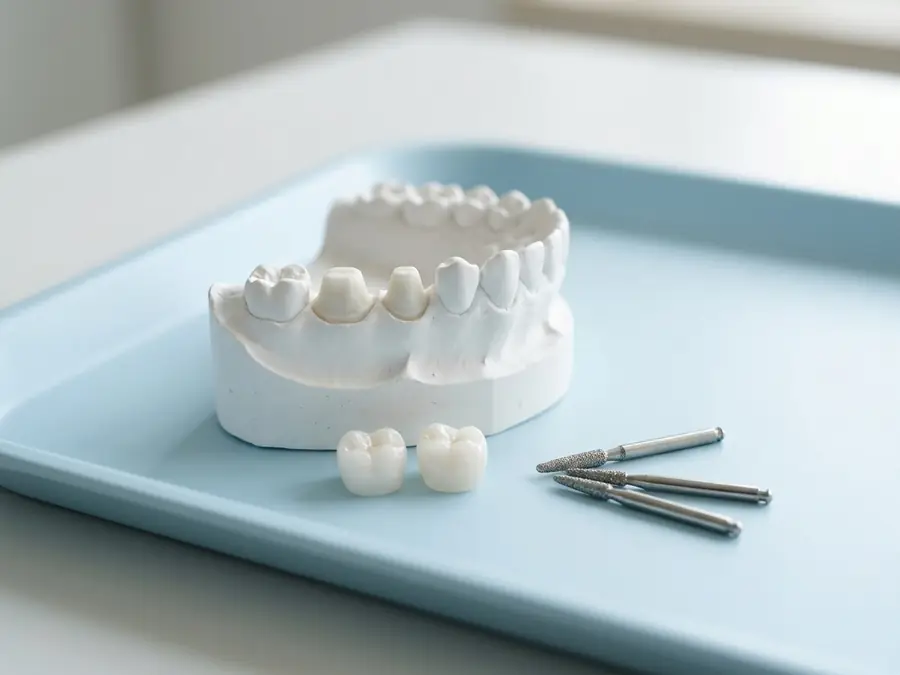
For a full crown, usually between half a millimetre and two millimetres is removed from each surface of the tooth, with more on the biting surface. For a porcelain veneer, it is mostly a reduction of less than a millimetre from the front surface only, and in some cases none is needed. Removed tooth structure doesn’t grow back. That is why, on healthy teeth, options that remove less tooth should be considered before a full crown is placed just to change colour or shape.
How much is removed for each type?
| Option | Approximate reduction | Note |
|---|---|---|
| Porcelain veneer | 0.3–0.7 mm from the front | Some cases can be done with no or minimal preparation |
| Bonding (composite) | Usually none | The enamel surface is roughened |
| Onlay | Only on weak cusps | Sound walls are kept |
| Zirconia crown | 0.5–1 mm on the sides, 1–1.5 mm on the biting surface | Thin monolithic zirconia needs less reduction |
| E.max crown | 1–1.5 mm on the sides, 1.5–2 mm on the biting surface | Needs some thickness for light transmission |
| Porcelain-fused-to-metal | 1.2–1.5 mm or more on the sides | Needs room for both the metal and porcelain layers |
Why does the tooth need to be reduced?
For a crown to sit on the tooth without making it look bigger than its natural size, room equal to the material’s thickness has to be made. A crown made without that room looks bulky, irritates the gum and upsets the bite. Removing more than necessary weakens the tooth and brings the preparation closer to the nerve. Good planning aims for the least reduction the chosen material needs.
Does prepared tooth grow back?
No. Enamel and the dentine beneath it don’t regenerate like bone or skin. A prepared tooth must stay covered by a crown or veneer for the rest of its life, and when a crown is replaced over the years, a little more tooth is usually lost. We explain whether enamel can repair itself in can tooth enamel be strengthened.
Does preparation harm the nerve?
The tooth is cooled with water during preparation, which is done under local anaesthetic. Mild sensitivity for a few days or weeks after a crown is common and usually settles; see what is normal in sensitivity after a crown. Many crowns or deep preparation can raise the chance that some teeth need root canal treatment in later years. That is why the amount of reduction should be planned around each tooth’s condition.
Should healthy teeth be crowned?
On sound teeth with no decay, large filling or fracture, a full crown shouldn’t be the first choice for changing colour or shape. These options are considered first, in this order:
- For colour: in-clinic or at-home teeth whitening.
- For small chips, gaps or shape: bonding, done without drilling the tooth.
- For marked colour or shape changes: minimal-preparation porcelain veneers.
- For crowding: orthodontics or clear aligners, which move teeth instead of cutting them; we compare these in crowded front teeth: crowns or orthodontics.
A full crown is a genuine treatment option to protect teeth with large losses, many fillings, root canal treatment or cracks.
Questions to ask before a crown
- Why does this tooth need a full crown, and is there an option that removes less tooth?
- Which material will be used, and how much reduction will it need?
- Can I see the result with a trial (mock-up) before any preparation?
- How many teeth are planned for crowns, and why does each one need it?
For more questions to ask at your appointment, see 12 questions to ask your dentist.
Crown planning at Dent32 in Beylikdüzü
When we plan crowns or veneers, we explain in the written treatment plan why each tooth needs treatment, how much reduction is involved and which options remove less tooth. In aesthetic cases we review a trial with you before any preparation; the process is described in smile design in Beylikdüzü.
Dent32 is at Barış Mah., Ginza Lavinya, E-5 Yanyolu No:30 D:179, 34520 Beylikdüzü, Istanbul and is open Monday to Saturday, 9:00–22:00. To book, call or WhatsApp +90 555 011 33 68, or use our contact page. At the examination we share the findings, the options and the approximate cost in writing; you are under no obligation to start treatment afterwards.
Frequently asked questions
How much tooth is removed for a zirconia crown?
Usually half a millimetre to one millimetre from the sides and one to one and a half millimetres from the biting surface. The exact amount depends on the type of zirconia, the tooth’s position and the bite.
Are teeth filed down for veneers?
Usually only the front surface is reduced, by less than a millimetre. If the teeth’s position and colour allow, some cases can be done with no or minimal preparation.
Does a prepared tooth grow back?
No. Enamel and dentine don’t regenerate; a prepared tooth must always stay covered by a crown or veneer from then on.
Should a healthy tooth be crowned?
A full crown on a healthy tooth just for colour or shape is not the first choice. Options that remove less tooth, such as whitening, bonding, veneers and orthodontics, should be considered first.
Does it hurt when teeth are prepared for crowns?
Preparation is done under local anaesthetic. Mild sensitivity can follow for a few days or weeks and usually settles on its own.