
Are dental X-rays harmful? Radiation doses, X-rays in pregnancy and for children
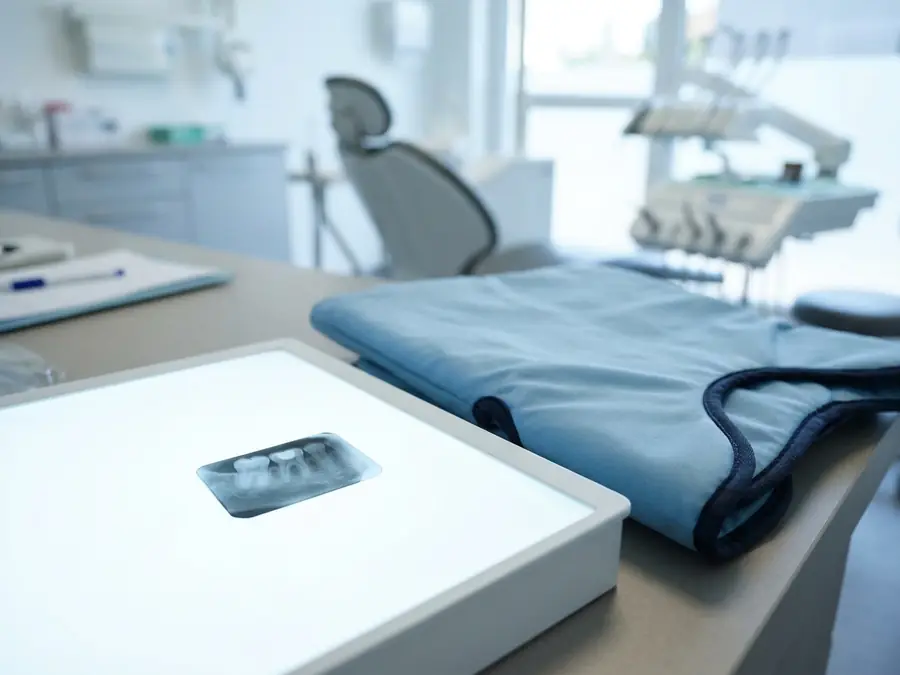
Dental X-rays are among the lowest-dose forms of medical imaging. A small film of one tooth involves less radiation than a person receives from natural background in a single day; a panoramic film is equivalent to a few days of natural radiation. Even so, like any radiation, it shouldn’t be repeated unnecessarily, so an X-ray is taken only when it will help with diagnosis or the treatment plan. Even during pregnancy, a necessary dental X-ray can be taken with suitable precautions.
How much radiation is in a dental X-ray?
Radiation dose is measured in microsieverts (µSv). The figures below are approximate and vary with the equipment, the area imaged and the settings. For comparison, a person receives on average 2,000–3,000 µSv a year from natural background (soil, air, space), or roughly 6–8 µSv a day.
| Image | Approximate dose | Comparison |
|---|---|---|
| Periapical or bitewing film (digital) | Under 5 µSv | Less than a day of natural radiation |
| Panoramic film | 10–25 µSv | A few days of natural radiation |
| Small-field dental CBCT | Tens of µSv | From a few days to a few weeks |
| Large-field dental CBCT | A hundred µSv or more | A few weeks of natural radiation |
| Long-haul flight | Tens of µSv | For comparison |
Why are X-rays needed?
Decay between teeth, infection at the root tips, bone loss and impacted teeth can’t be seen by eye during an examination. X-rays show these problems early, while they can still be solved with smaller, simpler treatment. We explain why decay between teeth is noticed late in decay between teeth, and the types of X-ray in dental X-rays and CBCT.
Can you have a dental X-ray when pregnant?
Routine check-up X-rays can be left until after the birth. But if an X-ray is needed for diagnosis because of pain, an abscess or an injury, it can be taken during pregnancy with suitable precautions. In a dental X-ray the beam is aimed at the mouth; the dose reaching the abdomen is extremely low. An untreated dental infection can be a greater risk to mother and baby.
If you are pregnant or think you might be, always say so before the X-ray. Details: dental treatment during pregnancy.
Can you have an X-ray while breastfeeding?
Yes. Dental X-rays don’t affect breast milk, and there’s no need to pause breastfeeding afterwards. See dental treatment while breastfeeding.
Dental X-rays for children
Children are more sensitive to radiation than adults, so how often X-rays are taken and the area covered are kept even more limited. A child at high risk of decay may need bitewings to see decay between teeth, or a panoramic film to check the order of eruption or a missing tooth. These X-rays have very low doses, and their benefit outweighs the problems a delayed diagnosis can cause. See when baby teeth fall out.
How often should X-rays be taken?
There is no fixed interval that applies to everyone. How often you need X-rays depends on your age, your risk of decay and gum disease, your symptoms and the treatment planned. An adult at low risk of decay may have bitewings years apart, while a tooth having root canal treatment or an implant may need a few small films during the procedure.
- If you’ve had X-rays at another clinic recently, bring a digital copy; it avoids an unnecessary repeat. See records when changing dentist.
- You are entitled to ask why an X-ray is needed.
- Depending on the clinic, a lead apron or thyroid collar may also be used; you can ask for one.
Digital X-rays and intraoral scans
Digital sensors capture images with a lower dose than old film X-rays, and the image can be looked at on screen straight away. An intraoral scanner is not an X-ray: it scans the surface of the teeth with light to take a digital impression and involves no radiation. See digital dentistry.
Imaging at Dent32 in Beylikdüzü
If an X-ray is needed, we explain beforehand why and which image is enough, and look at the images on screen together with you during the examination. We also take recent images you bring into account.
Dent32 is at Barış Mah., Ginza Lavinya, E-5 Yanyolu No:30 D:179, 34520 Beylikdüzü, Istanbul and is open seven days a week. To book, call or WhatsApp +90 555 011 33 68, or use our contact page. At the examination we share the findings, the options and the approximate cost in writing; you are under no obligation to start treatment afterwards.
Frequently asked questions
Do dental X-rays cause cancer?
Dental X-ray doses are very low; a small tooth film is less than a day of natural radiation. Even so, unnecessary repeats are avoided and X-rays are taken only when needed.
How many days of radiation is a panoramic X-ray?
Roughly, a panoramic film is equivalent to a few days of natural background radiation. The dose varies with the equipment and settings.
Can I have a dental X-ray while pregnant?
Routine X-rays can wait until after the birth; an X-ray needed because of pain, an abscess or an injury can be taken with suitable precautions. Tell the clinic you are pregnant before the X-ray.
How many dental X-rays a year are safe?
There’s no fixed number. How often depends on your age, decay risk, symptoms and planned treatment, and is decided by your dentist.
Is a dental CBCT scan harmful?
A dental CBCT has a higher dose than a panoramic film but a much lower dose than a medical CT scan. It’s used when a two-dimensional film isn’t enough, such as for implant planning.