Dental abscess and facial swelling: will it go away on its own, and when is it an emergency?
A dental abscess is a pus-filled infection at the tip of a tooth's root or in the gum, and it doesn't go away on its own. Even if the abscess bursts and the pain eases, it comes back unless the source of the infection is treated. Treatment means draining the abscess and removing the source with root canal treatment, gum treatment or extraction. Fast-growing facial swelling, difficulty swallowing or breathing, and a high fever are emergency signs.
What is a dental abscess, and what causes it?
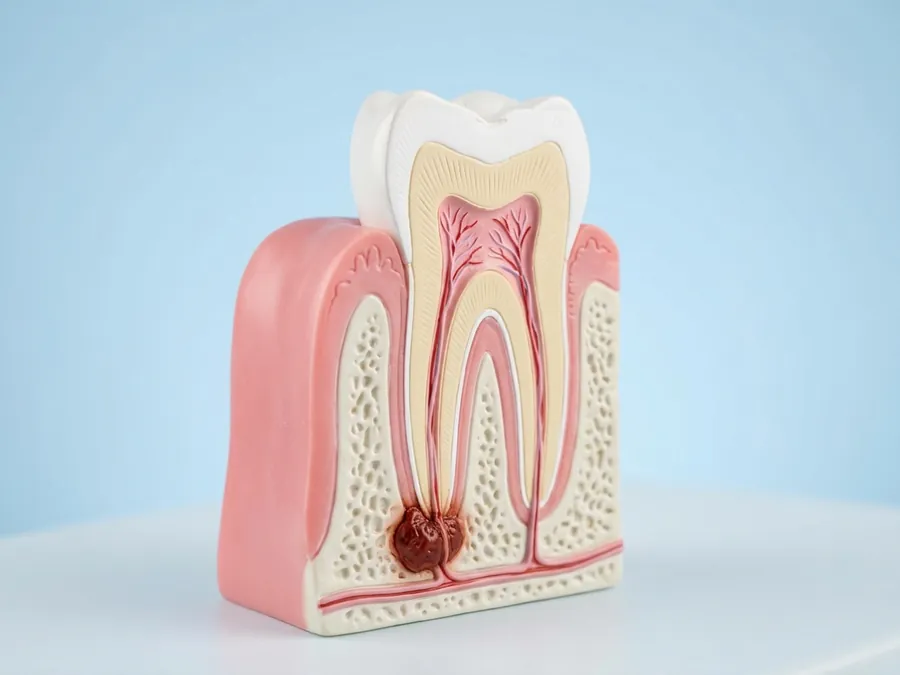
An abscess is a collection of pus that forms when the body walls off a bacterial infection. There are two main types in teeth:
- Root tip (periapical) abscess: Deep decay or a crack kills the tooth's nerve, and infection spreads from the root tip into the bone.
- Gum (periodontal) abscess: Develops in the pocket between tooth and gum in advanced gum disease.
An abscess can also develop in teeth that have already had root canal treatment or a crown, if the canals weren't fully cleaned or there is leakage under the crown.
Symptoms
- Throbbing, constant pain that gets worse at night
- Severe pain when biting or touching the tooth
- A pimple-like swelling on the gum, sometimes with discharge
- Swelling in the cheek, jaw or under the eye
- A bad taste or smell in the mouth
- Fever, feeling unwell, swollen lymph nodes in the neck
| Symptom | What to do |
|---|---|
| Fast-growing facial swelling, spreading to the eye or neck | A&E or call 112 immediately |
| Difficulty swallowing or breathing, unable to open the mouth | A&E or call 112 immediately |
| High fever and feeling very unwell | See a doctor the same day; if worsening, A&E |
| Limited gum swelling with pain | Dentist the same day or next day |
| Small bump with discharge on the gum, no pain | Dentist within a few days |
Does an abscess go away on its own? Are antibiotics enough?
No. Antibiotics can help control spreading infection and fever, but they can't reach the dead nerve tissue or gum pocket at the source. Once the course ends, the abscess often comes back. That's why antibiotics are used alongside treatment when the dentist thinks they're needed, not as treatment on their own. Details: do antibiotics cure toothache?.
How is an abscess treated?
- Examination and X-ray: The source and spread of the abscess are identified.
- Drainage: If needed, the pus is drained by opening the tooth or through a small cut in the gum; pain usually eases quickly.
- Treating the source: Root canal treatment for the tooth, or deep cleaning and gum treatment for a gum abscess.
- A tooth that can't be saved: If the tooth can't be restored, it's extracted and replacing it is planned.
- Protection: After root canal treatment, a crown is often recommended so the tooth doesn't fracture.
Until you see a dentist
- Take a painkiller your doctor has previously said is suitable for you, at the dose on the pack.
- Apply cold to the cheek; avoid heat, which can help the infection spread.
- Rinse gently with warm salt water.
- Don't try to burst the gum swelling with a needle or sharp object.
- Don't start old antibiotics you have at home on your own.
For an abscess or swelling that starts at the weekend in Beylikdüzü, see our on-call and emergency dentist guide, or send a photo to Dent32 on WhatsApp (+90 555 011 33 68) to ask for a same-day assessment.
Frequently asked questions
Does a dental abscess go away on its own?
No. Even if the abscess drains and the pain eases, it comes back unless the source of the infection is treated.
Can an abscessed tooth have root canal treatment?
Yes. Most abscessed teeth can be saved with root canal treatment; the pus is drained first if needed.
Which antibiotic is used for an abscess?
Whether you need an antibiotic, and which one, is decided by the dentist after an examination. Don't start antibiotics on your own.
Can a tooth be taken out if my face is swollen?
Sometimes the infection needs to be controlled first; sometimes taking the tooth out lets the pus drain. The decision is made at the examination.
Is an abscess dangerous?
If untreated, the infection can spread into the face and neck. With fast-growing swelling and difficulty breathing, go to A&E.