Congenitally missing teeth (agenesis): options when a lateral incisor or premolar never came in
In some people one or more adult teeth never form; this is called tooth agenesis. Leaving wisdom teeth aside, studies put it at roughly 2–10% of people having at least one congenitally missing adult tooth. The teeth most often missing are the lower second premolars and the upper lateral incisors. It's usually noticed when a baby tooth doesn't fall out on time, or on an X-ray in childhood. The treatment option depends on age, which tooth is missing and the space in the jaw; ideally the decision is made before growth ends.
How it's noticed
- A baby tooth that falls out much later than in peers, or never becomes loose. See when baby teeth fall out.
- Unexpected gaps between the front teeth
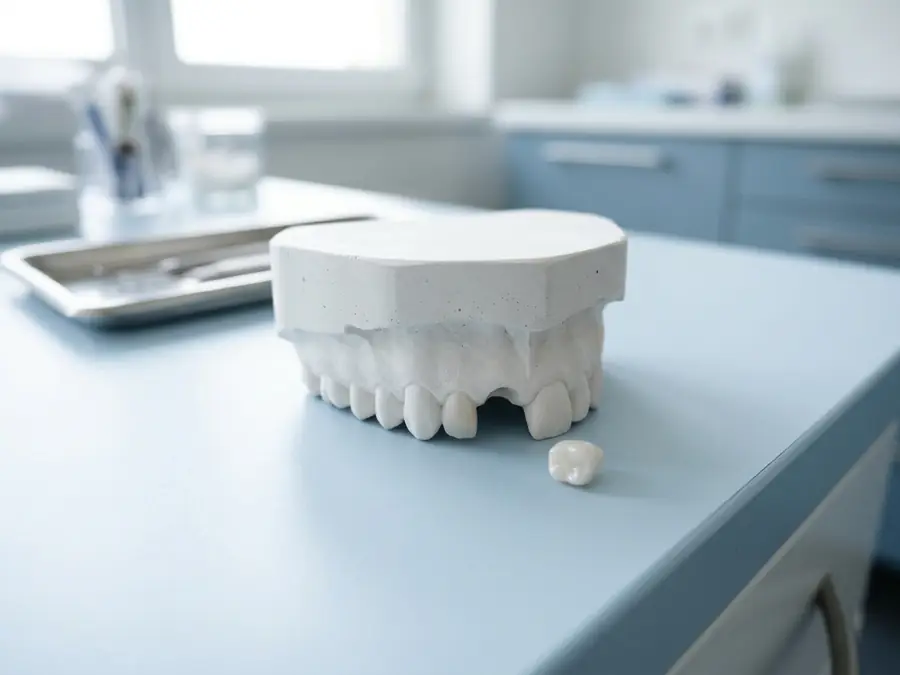
- A lateral incisor on one side but not the other, or one that is very small and pointed
- No tooth bud visible on a panoramic X-ray
Diagnosis is confirmed by X-ray. Several missing teeth can be linked to certain syndromes, in which case a broader assessment is needed. A missing lateral incisor can also lead to an impacted canine; see impacted canines.
Keeping the baby tooth
A baby tooth with no adult tooth beneath it, especially in the lower premolar area, can be used for many years, sometimes well into adulthood, as long as its root stays sound. It should be protected from decay and checked regularly. Over time its root may dissolve, it may loosen or sit lower than the teeth around it; other options are then considered.
Treatment options
| Option | Suitable for | Note |
|---|---|---|
| Closing the gap with orthodontics | Crowded mouths, especially in growing children | If a lateral incisor is missing, the canine can be moved forward and reshaped |
| Keeping the space for a later implant | Cases where the space is to be kept | Implants are placed after growth, usually from 18 |
| Bonded (winged) bridge | Front teeth, without cutting the neighbours | Until implant age in young people, or long term |
| Reshaping with bonding | A small or pointed lateral incisor | Size and shape corrected without cutting the tooth |
| Removable temporary denture | Children who are still growing | Temporary solution |
Details: a single missing tooth, implant or bridge, what is bonding.
Why timing matters
Deciding early in children keeps options such as orthodontic gap closure open. If the space is to be kept for an implant, the teeth mustn't drift into it and there must be enough room between the roots; this is usually achieved with orthodontics. An implant placed while the jaw is still growing can end up higher than the other teeth over time, because the natural teeth keep developing. That's why implants wait until growth is complete. See early orthodontics for children.
Missing teeth in adults
When the absence is noticed in adulthood or the baby tooth is lost, implants, bridges or orthodontics combined with an implant are considered. Bone in the gap may have thinned over the years; this is checked on a CT scan and a bone graft planned if needed. See dental implants in Beylikdüzü, orthodontics for adults.
Planning in Beylikdüzü
At Dent32 we explain the age-appropriate options for congenitally missing teeth in writing, based on the baby tooth's condition, a space analysis and the X-ray findings. For children we decide together with the family, with growth in mind.
Dent32 Ağız ve Diş Sağlığı Polikliniği (Dent32 Dental Polyclinic) is at Barış Mah., Ginza Lavinya, E-5 Yanyolu No:30 D:179, 34520 Beylikdüzü, Istanbul and is open seven days a week. To book, call or WhatsApp +90 555 011 33 68, or use our contact page. At the examination we share the findings, the options and the approximate cost in writing; you are under no obligation to start treatment afterwards.
For clinic details, our dentists and the full list of treatments, visit Dent32, dental clinic in Beylikdüzü.
Frequently asked questions
Which teeth are most often congenitally missing?
Apart from wisdom teeth, the lower second premolars and upper lateral incisors are most often missing.
Should the baby tooth in place of a missing adult tooth be extracted?
If its root is sound and it works well, it's usually kept. If extraction is needed, the plan for afterwards (orthodontics, an implant or a bridge) should be decided first.
Can my child have an implant?
Implants aren't advised while the jaw is still growing; they usually wait until 18 or later. Until then a bonded bridge or temporary denture can be used.