
All-on-Four: are fixed teeth on four implants really possible?
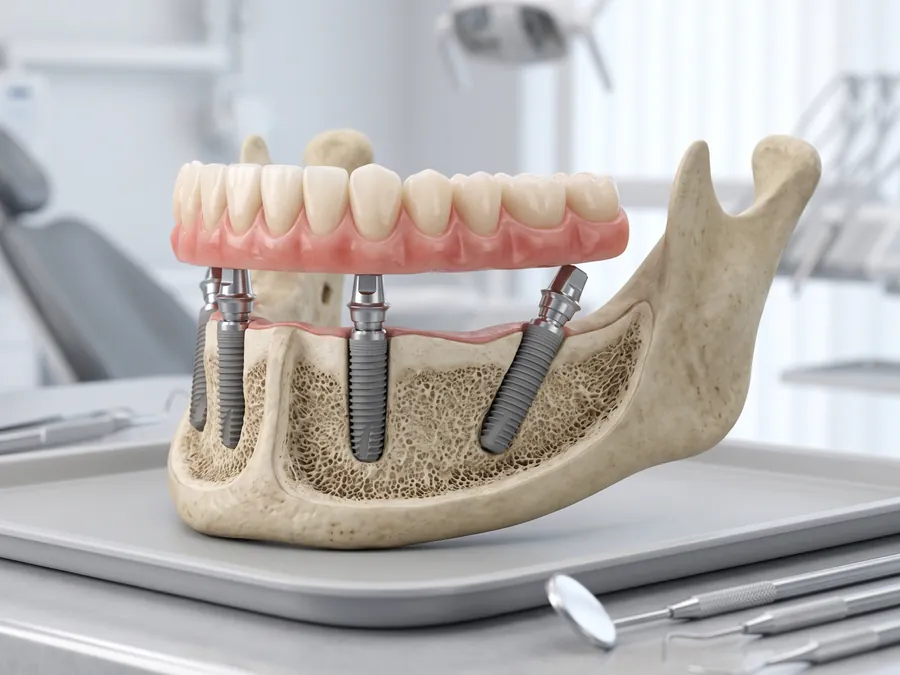
All-on-Four is a treatment in which a fixed full-arch prosthesis is placed on four implants in a jaw that has no teeth or is about to lose them.
How does All-on-Four work?
In a conventional approach, six to eight implants may be planned for a full jaw. All-on-Four uses four: the two front implants are placed upright and the two back implants at an angle.
The angled back implants take support from areas where the bone is denser. This keeps them away from the sinus in the upper jaw and the nerve in the lower jaw, which reduces the need for bone grafting in many patients.
Who is it suitable for?
- People missing all teeth in one jaw
- People whose remaining teeth cannot be saved because of advanced gum disease
- Denture wearers who want fixed teeth
- Patients whose CT scan shows enough bone for four implants
Uncontrolled diabetes, heavy smoking, a history of head and neck radiotherapy and certain bone medications increase the risk. These should be discussed in detail at the examination.
Are same-day fixed teeth possible?
If the implants achieve enough initial stability (primary stability) in the bone, most patients can have a temporary fixed prosthesis fitted the same day or within a few days, so you are not left without teeth while healing.
The temporary prosthesis is used until the bone has fused with the implants. A soft diet is needed in the first weeks. The final prosthesis is made from new impressions after healing.
How are the process and timeline planned?
| Stage | Typical time |
|---|---|
| Examination and 3D CT scan | 1–2 appointments |
| Any extractions, implant surgery and temporary fixed prosthesis | Usually the same day or within a few days |
| Healing and bone integration | About 3–6 months |
| Making and fitting the final prosthesis | Several appointments |
| Check-ups and professional cleaning | At least 1–2 times a year |
These are general ranges; they vary with bone quality and general health.
What are the risks and limitations?
When well planned, All-on-Four is a predictable treatment, but like any implant treatment it carries risks:
- An implant failing to integrate with the bone (more common with smoking and uncontrolled diabetes)
- Inflammation around implants (peri-implantitis), mostly linked to inadequate cleaning
- Fracture or wear of the prosthesis in people who clench or grind at night
- The prosthesis needing maintenance or renewal in the long term
The underside of a fixed prosthesis must be cleaned too. Interdental brushes and a water flosser should be part of the daily routine, as your dentist will show you.
What determines the cost?
| Factor | Explanation |
|---|---|
| Implant system | Clinical evidence and long-term parts availability matter |
| Final prosthesis material | Acrylic, composite or zirconia differ in cost and durability |
| Additional procedures | Extractions or limited bone grafting may be needed |
| One or two jaws | Each jaw is planned separately |
Frequently asked questions
Can four implants carry all the teeth?
With suitable bone and correct planning, yes. Angled back implants spread the load over a wider area. If bone is insufficient, more implants may be recommended.
Will the surgery hurt?
It is done under local anaesthetic; sedation can be discussed if you wish. Swelling and tenderness may follow for a few days and are managed with prescribed medication.
Can I eat normally with temporary teeth?
A soft diet is recommended for the first weeks. Hard and sticky food can overload the implants until the bone has integrated.
Can the All-on-Four prosthesis be removed?
Not by the patient. Because it is screw-retained, the dentist can remove it for cleaning at check-ups.
Is All-on-Four suitable for everyone?
No. A decision can't be made without a CT scan and an assessment of general health and bone volume. For some patients a conventional implant plan is better.